What Can A Humble Bit Of Terracotta Achieve? The Sundarban Story
First published in Sanctuary Asia,
Vol. 44
No. 10,
October 2024
By Neha Sinha
The last time I was in the Sundarban, the area was under the shadow – or the cloud – of an impending cyclone. The air was overcast, a warm soup that everyone had to trundle through. Birds called from the mangroves, emerging cautiously, and people hoped the cyclone would not make landfall.
This is how it is in this neck of the woods: people and wildlife live between storms. After each storm begins the process of rebuilding; the Sundarban is an area of contrasts. With its fierce-looking, tenacious mangroves and wetlands, it can look like a forest out of a fairy tale. Yet, this fairy tale has a bite: the delta is shrinking and sinking, and is storm-battered by extreme events such as cyclones and rainstorms. What looks calm can frequently become inhospitable. Land that is visible today may be eaten by the sea tomorrow. This is also the only place in the world with swamp tigers, even as the area changes. It is clear that the conservation of biodiversity and the well-being of people must be linked to climate resilience and adaptation.
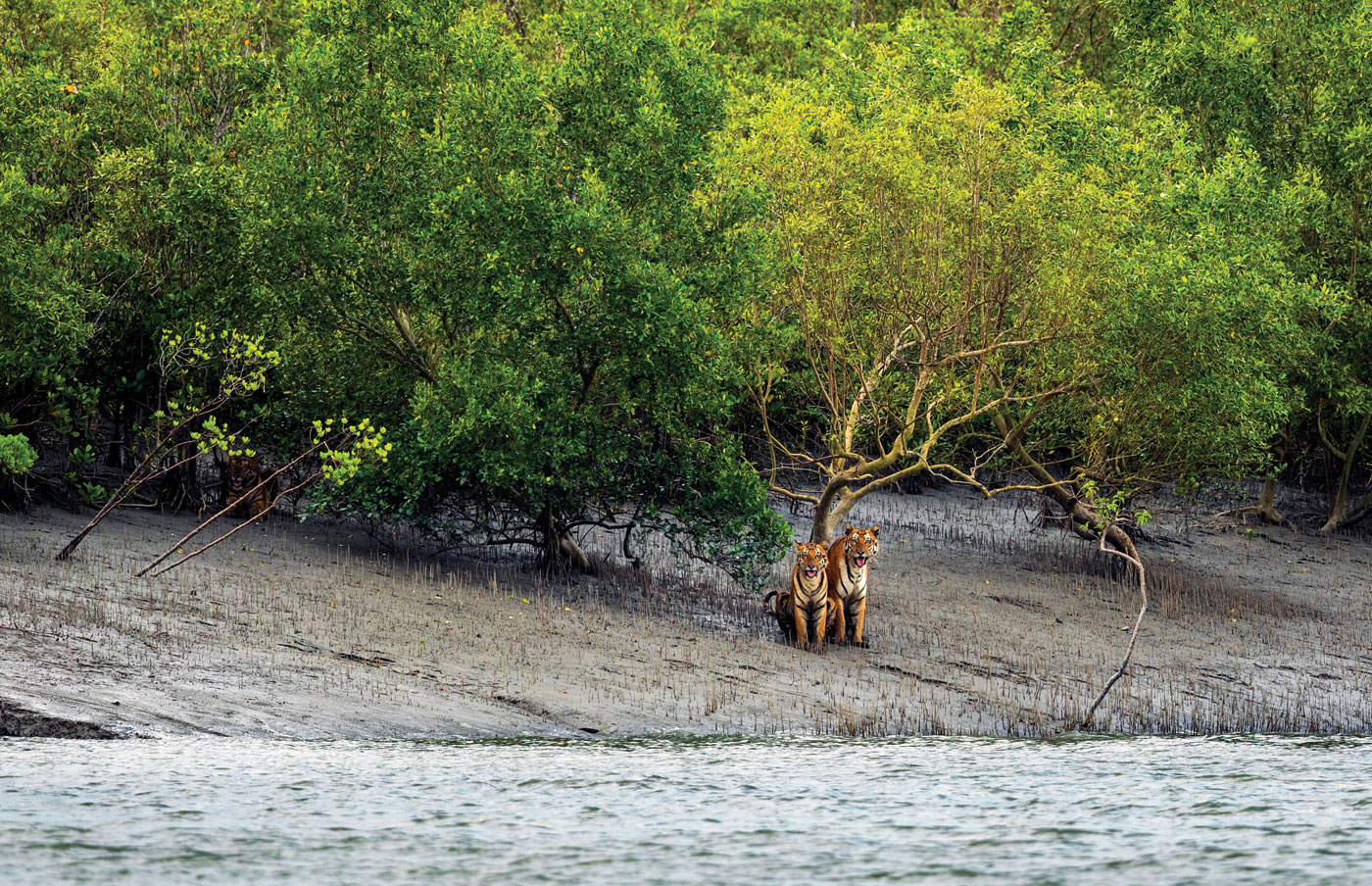
Through the sweltering heat, a tigress and her cub emerge through mangrove cover. Just like their stripes camouflage them in dry grasses, they also assist them in blending into mangrove roots and tiger palms. Photo: Vinit Bajpai.
One way to achieve this is by securing the land. “The Sundarban landmass is shrinking because of processes of erosion. There is also effective sea level rise. A new delta undergoes a process called auto-compaction. This is enhanced if there is removal of subsurface water. In short, we are losing land in the Sundarban. And when we lose land, we lose forest. When the land is rebuilt or restored, it doesn’t have the same forest,” says Dr. Anurag Danda, Director, Sundarbans Delta programme, WWF-India. The challenge, therefore, is not only to attempt climate resilience in the area, but also to ensure that solutions are nature-based to avoid the creation of new problems.
Securing The Shoreline
One of these solutions is earthy and is proving to be effective. A ring of baked earth – terracotta – is used to secure the land. WWF-India has placed thousands of terracotta rings in human-inhabited as well as forested areas of the Sundarban to secure the shoreline. When the high tide comes in, bearing silt, the rings trap the silt, preventing erosion and stabilising elevation. First attempted one-and-a-half-years ago, this proof-of-concept is showing good results. WWF-India has installed over 8,000 silt traps covering over 3,800 square metres across seven sites in three forest-fringe islands (G-Plot in Patharpratima Block, and Satjelia and Kumirmari in Gosaba Block), and over 2,800 silt traps covering over 1,480 square metres across three sites in Dhanchi (a forest island, next to Patharpratima). To create an additional line of defence, oyster reefs have been made in some of these locations. A year later, the oysters are thriving, and the terracotta rings are replete with silt. The captured silt can now be used for mangrove regeneration. The vision is for a living shoreline that can be used by wildlife and people.
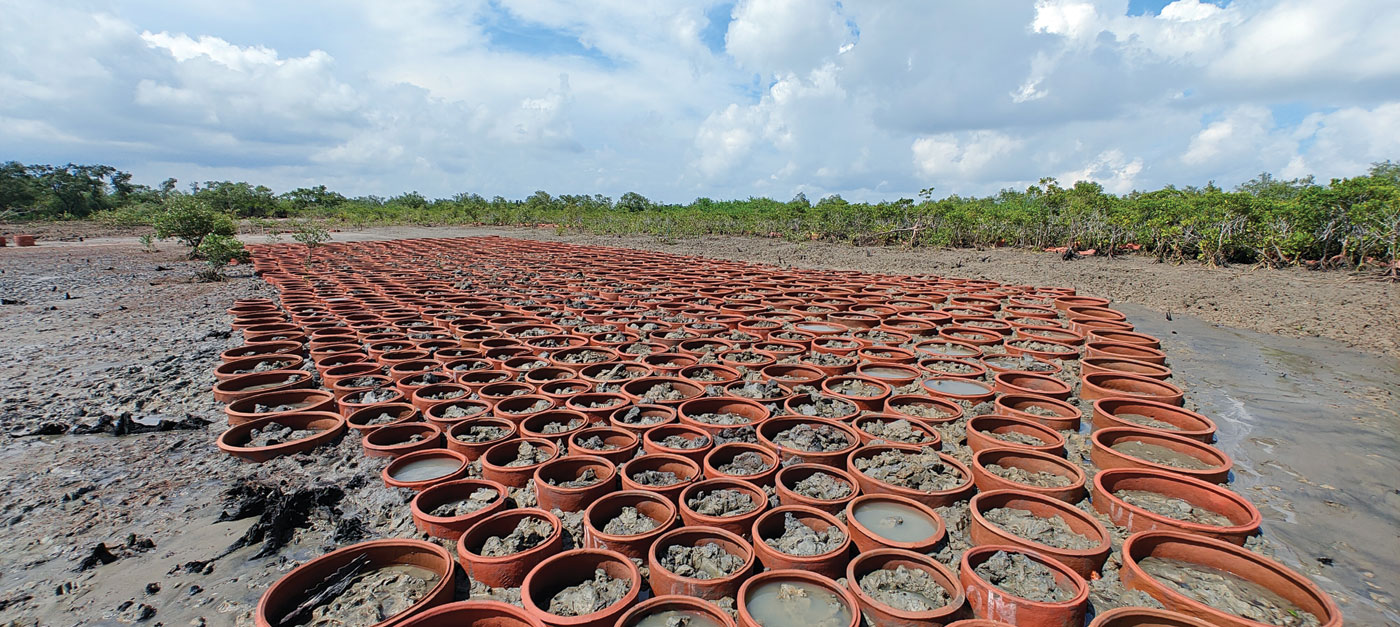
In between storms and forceful waves, the Sundarban faces massive shoreline erosion, making the landmass shrink. WWF-India has placed thousands of terracotta rings in human-inhabited as well as forested areas to stabilise the shoreline, reduce erosion, and maintain elevation. Photo: Neha Sinha.
Minimising Human-Wildlife Conflict
It can be tough to spot tigers in the mangroves, but there are at least 101 of them in India’s Sundarban as per the last All India Tiger Estimation. The WWF-India team did an analysis of human-wildlife conflict incidents in all 46 forest fringe villages, where conflict has occurred since 2019. Out of the total 46 forest fringe villages, cases were reported from 27 villages. Out of a total of 101 cases, 92 occurred when people entered forests. Nine were recorded from outside the forest area. There was only one case of a tiger entering a village to predate on livestock.
Of the 92 cases, 68 occurred while people were collecting crabs from inside the forest. It is thus imperative to assist people with livelihood options that reduce entering the forest. WWF-India has initiated a network of Prokriti Bondhus (Friends of Nature), who help resolve human-wildlife situations in their villages, and explore new livelihoods. We hope that a particularly nutritious leaf can be part of the solution. The leaf is moringa, and the community has great interest in moringa’s potential. Together, WWF-India has started moringa nurseries in the area, so it can be grown and the leaves be processed for sale as moringa powder. Fish cages are also being made near forest-fringe islands so people can fish closer to habitation.
With the terracotta rings experiment showing encouraging findings, the vision is to safeguard more shorelines, covering more forested areas. Ultimately, more forest and more prey is what the tiger needs. “Unlike Central India or other parts of the world, the swamp tiger of the Sundarban does not have a lot of prey to choose from. Tigers here are limited by a lack of herbivores. They eat mostly wild pigs and chital deer. We must de-escalate the process of erosion, and secure the land for them,” Danda says.
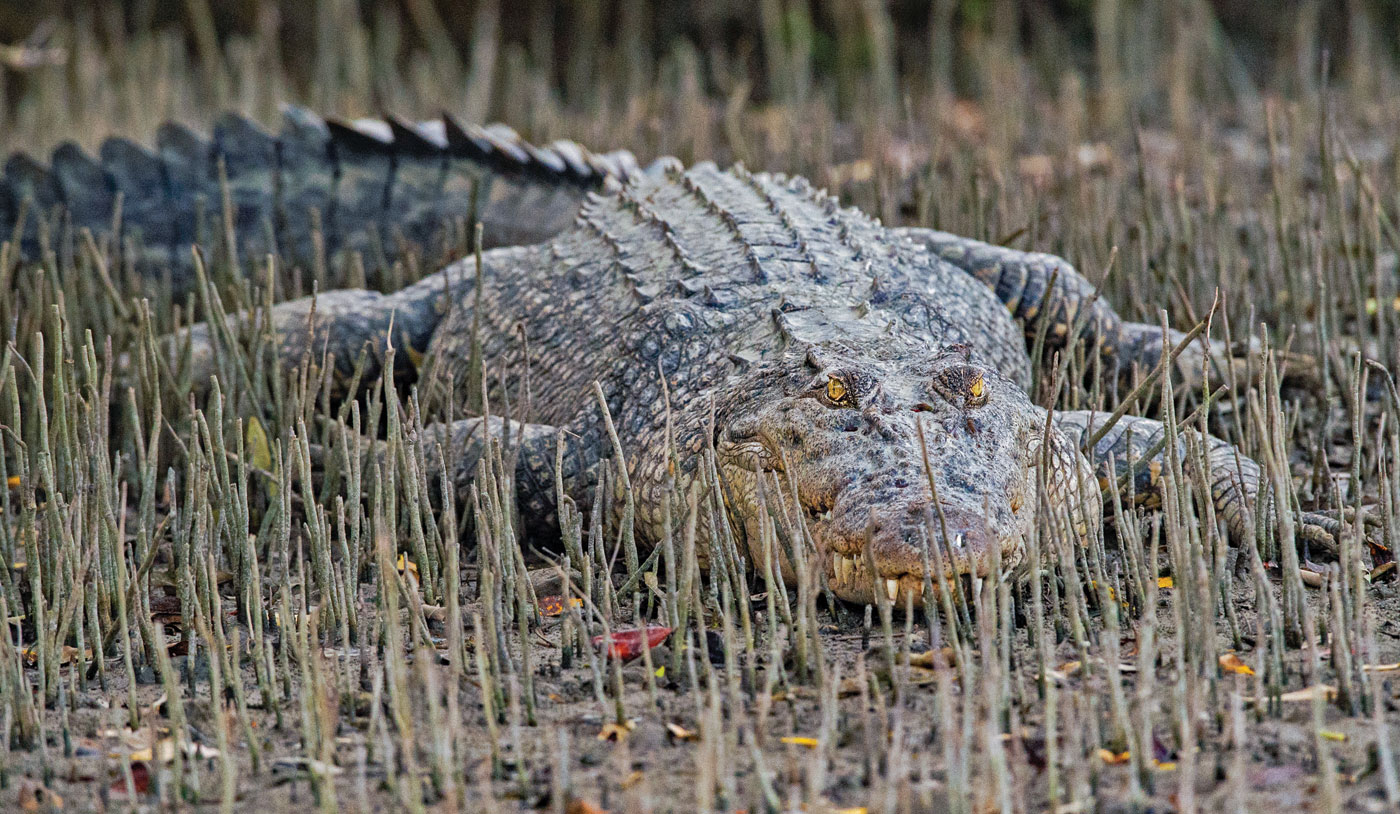
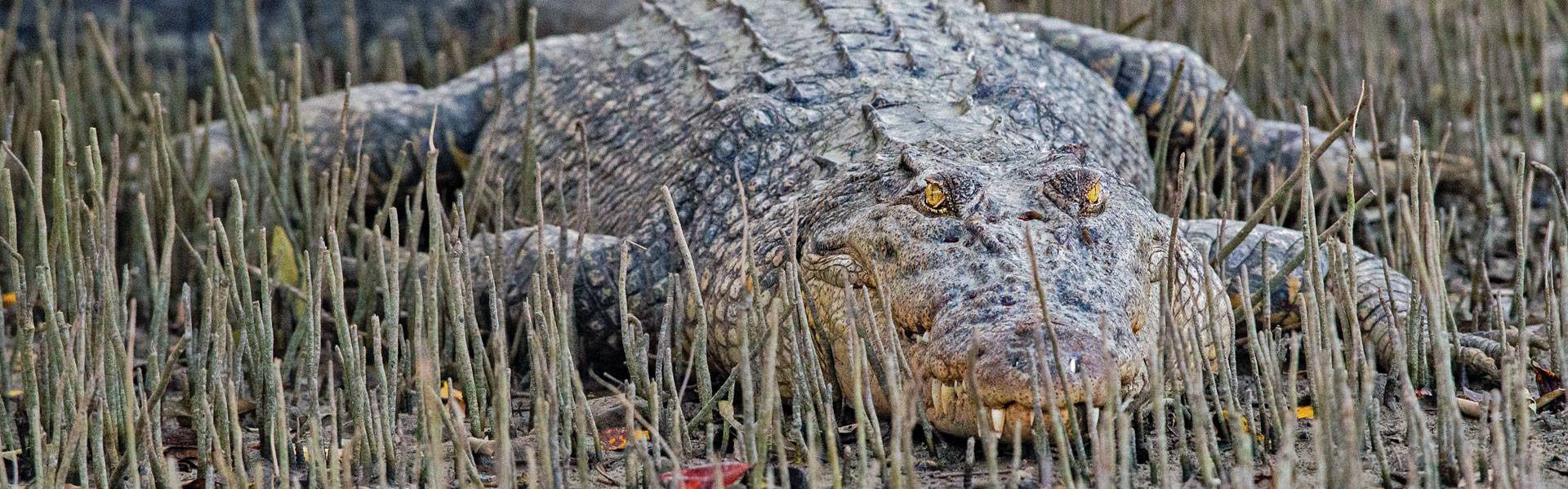
The Sundarban is a UNESCO World Heritage site known for its biodiversity. This swamp forest hosts more than 300 plant, 58 mammal, 240 bird, and 55 reptile species including the saltwater crocodile. Photo: Dhritiman Mukherjee.
And what a land it is: rich in silt, also rich in wildlife. When wildlife enthusiast Colonel Vinit Bajpai visited the Sundarban this August, he was confounded by the signs of the land. This is not a place which resounds with alarm calls – the naturalist’s way of honing in on tiger movement – because there is low prey density here. Everything leaves a mark on the soft, fine mudflats of the mangroves, but tiger pugmarks can get washed away with the high tide.
“From a moving boat, pugmarks can look confusingly similar to drag marks; meanwhile, holes made by crabs can look like pugmarks,” Bajpai says. He waited four days to sight a female tiger and her cubs. For a few moments, the tigers merged into (aptly named) tiger palm (also called hetal). The palm has long, sharp leaves. A clump of tiger palm looks fierce, lineated, striped – like a tiger in vegetal form. Bajpai says, “We went to the tiger palm patch and sighted the head of a sub adult emerging from the identically coloured tiger palm leaves. We waited patiently and soon the female also emerged and joined the sub adult cub. She spray-marked a particular bush, and after observing us for a few seconds, disappeared again with the cubs. We waited for the entire day for them to emerge again but they chose to remain hidden. Nevertheless, it was an unforgettable sighting of the swamp tigers.”
Perhaps that is the enigma and allure of the Sundarban: a place where land becomes water, palms become tigers, and nature yields both fury and abundance. As I write this, I remember a Collared Kingfisher calling from a place I couldn’t see; a basking saltwater crocodile and foraging Lesser Adjutant Stork I did see, aware that the tiger may have seen us, watching our actions and the search for timeless solutions.
Neha Sinha, a conservation biologist and author, heads Conservation Partnerships at WWF-India.