

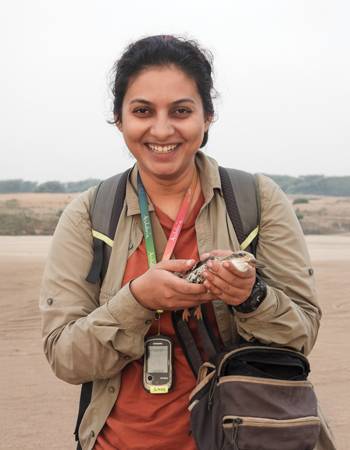
Parveen Shaikh
The Sanctuary Wildlife Service Awards 2025
Researchers, frontline defenders, forest officials, communicators, inspired wildlifers, and others who dedicate their lives to protecting the biosphere are our Wildlife Heroes. There are so many brilliant individuals who live for the wild, with compassion, determination and courage, from among whom we chose these five individuals. They are an inspiration!
Parveen Shaikh
Avian ecologist, conservationist, nest guardian
With its little belly, the Indian Skimmer Rynchops albicollis made a depression in the sand bar by the flowing Chambal to lay its eggs. Little did it know that a lot had changed with the river – higher water needs, dams, sand mining, and lift irrigation, to name a few, which could threaten its future.
But not with Parveen Shaikh, a conservation scientist par excellence, assuming responsibility! On the shifting sandbars of the Chambal river, Shaikh has been leading a remarkable conservation story for the Indian Skimmer since 2012. She and her team have made steady progress to save the bird through research and communication skills that have roped in considerable support from the local community, the Forest Department, and even from religious leaders! With over a decade of experience in avian ecology and species conservation, her pioneering work combines rigorous ecological monitoring with strong community engagement, particularly along major river systems such as the Chambal and Mahanadi.
Currently a Scientist with the Bombay Natural History Society (BNHS), Shaikh is also the founder and coordinator of the Indian Skimmer Count – a citizen science initiative that has mobilised birdwatchers across the species’ range since 2020. She has played a key role in compiling national species status reports under the Central Asian Flyway Action Plan, and continues to contribute to scientific publications, technical reports, and stakeholder training programmes. Her work includes developing long-term nest monitoring protocols, conducting bird ringing and banding to study the migratory movements of skimmers, and formulating species-specific national conservation action plans.
Shaikh’s journey with Indian Skimmers, she says, was born of curiosity. A Mumbai resident, she first travelled to the Chambal when little was known about the species – only that they nested along the riverbanks. The Chambal, home to a significant portion of the global Indian Skimmer population, is a crucial breeding habitat. Early in her research, Shaikh observed that eggs and chicks were heavily predated by free-ranging dogs and jackals, leaving barely any of the three or four chicks per nest alive or capable of flight. Alarmed, she and her team set out to protect the vulnerable colonies, ultimately developing the Nest Guardian Programme.
All her conservation efforts blend rigorous science with community participation. Local residents are trained and employed to guard and monitor nests, record data, and intervene when eggs or chicks are at risk – from predators or wandering cattle. For many participants, this is the first time they have seen themselves as stewards of the river rather than mere users of its resources. “When communities become guardians,” Shaikh notes, “conservation stops being an outsider’s job.” The results speak for themselves: in 2024, the number of nesting birds rose to over 800, from about 400 in 2017. Overall nest survival in the National Chambal Sanctuary improved too, from under 15 per cent to over 25 per cent.
The programme’s impact now extends beyond skimmers, benefiting other species that nest on the same sandbars. This includes the endangered Black-bellied Tern, Little Tern, River Tern, Small Pratincole, and even riverine turtles.
Shaikh acknowledges that her journey has been supported by many hands – her teachers, mentors like Dr. Asad Rahmani (former BNHS Director) and his successors, colleagues and friends such as Delip K. Das (Bisharga), plus grant agencies including the Conservation Leadership Programme and BirdLife International. “This would not have been possible without my husband’s and parents’ constant support,” she adds. Securing funding for a species that was not yet endangered was a formidable challenge, but Shaikh often jokes that she owes a debt of gratitude to the dacoits of Chambal whose presence, in an unexpected way, helped protect the river and its biodiversity. Undeterred by the region’s notoriety, she continued her fearless forays into skimmer conservation.
The Forest Departments of Madhya Pradesh, Uttar Pradesh and Rajasthan proved immensely supportive, providing full on-ground assistance given the challenges of being a woman researcher working in difficult terrain. She also received help from Harigir Maharaj, a local religious leader who used his influence to temporarily halt sand mining on a sandbar until the chicks had fledged. He even conducted a puja for the success of the nests.
Shaikh holds a master’s degree in Environmental Science, and was placed first in her university when she graduated. Since then she has received several prestigious awards and fellowships, including the Graeme Gibson Fellowship (BirdLife International, 2023–24), the Conservation Leadership Programme’s Future Conservationist and Continuation Awards (2016, 2021), and the Ravi Sankaran Fellowship (Inlaks, 2018).
A passionate advocate for inclusive and science-based conservation, Parveen Shaikh is a true guardian of the Indian Skimmer and its Chambal habitat. She continues to bridge the gap between field research and policy through collaboration, training, and public outreach. For this, we honour Parveen Shaikh with a Sanctuary Wildlife Service Award, 2025.