Between Boulders And Borders: The Brown Bears Of Kargil
First published in Sanctuary Asia,
Vol. 45
No. 12,
December 2025
By Preet Sharma
It was a cold starless night in Drass. The village slept under a silence as profound as the mountain peaks that surrounded us. I was sharing a small room with Ahmad Ali, a local guide and patrolling personnel working for the Department of Wildlife Protection, Kargil. Ahmad possessed an almost spiritual connection with the Himalayan brown bear. Locals called him lammergeier, for he could spot bears from more than a kilometre away.
Suddenly, the silence broke. Ahmad sprang out of bed, pulling on his jacket. “Dren Mo aaya hai, Matayen mein,” he said, “The bear has come to Matayen.” My colleague Kazim, a seasoned field man, and I grabbed our flashlights and jackets, and rushed out into the -60 C night, looking for any movement of our frantic visitor through narrow lanes lit by our torchbeams. The air was biting cold and thin.
We arrived at a small, single-storey home where a large window pane had been pushed out cleanly, leaving a gaping black hole. Ahmad crouched low, tracing the large, muddy paw prints in the frost, broader than my outstretched palm, unmistakably a Himalayan brown bear. “They’ve learned how to do it,” he whispered. “They find the weak spot and push gently. So quiet. No one hears.” The bear had slipped in, took what it could,
and vanished. We scanned the fields using flashlights, but Ahmad knew the ridges it would follow and the den to which it would return. We were too late. That night was another reminder of a conflict that has been escalating across Ladakh: the struggle of a magnificent creature trying to survive in a shrinking world, and of people learning to share their lives with it.
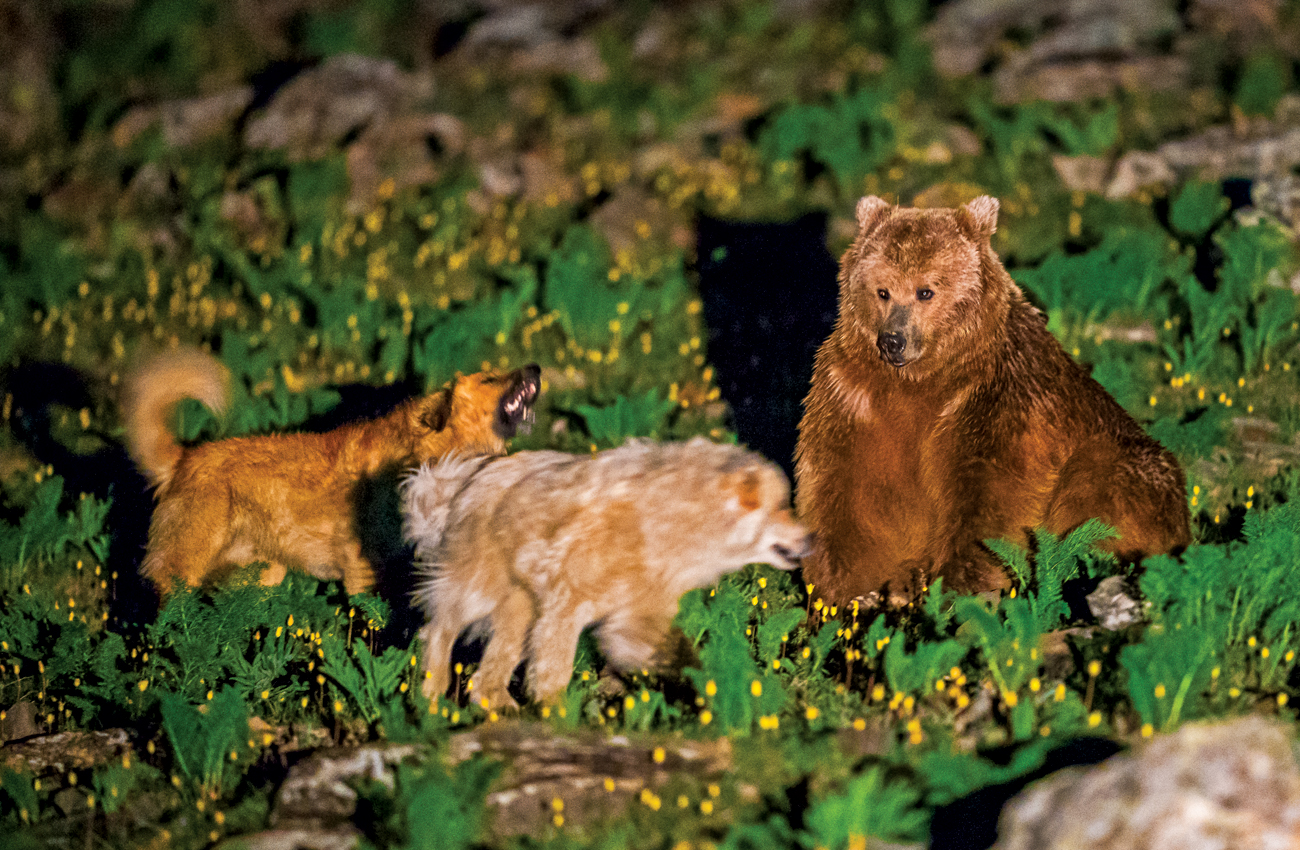
As the endangered Himalayan brown bear, a rare and elusive giant of India’s high mountains, descends to lower altitudes and enters human-modified landscapes, it encounters packs of feral dogs that chase, harass, and attack it, posing a serious threat to its survival. Photo: Dhritiman Mukherjee.
Tales And Trophies
To understand the Himalayan brown bear Ursus arctos isabellinus today, one must look back at its long journey through myth, history, and science. Its earliest appearances are not in forests or mountains, but in the imagination. Ancient Indian epics speak of Jamba Vantha, the bear king, protector and advisor. Legends echo in Drass, where places such as Bhimbat and Draupadi Kund are both linked to such epics. Folktales across the Himalaya portray bears as wise teachers, as in the story of Ahmed and Nadeem, and in some as stubborn thieves. In Drass, some villagers even jokingly refer to the bears as the “infamous insurgents of the mountains”, routinely raiding limited food stores. Traditional ecological knowledge adds further richness. Locals distinguish between spang-den, the lighter, grass-eating bear, and shea-den, the darker bear thought to favour meat. While these may reflect seasonal coat changes, sexual dimorphism or simple observation, they reveal how closely communities have studied the Dren-Mo.
There were also myths of a strange animal called the yeh-teh, or more commonly the ‘yeti’, even in English circles. Many of these stories likely arose from the pugmarks of brown bears resembling large footprints and their occasional habit of walking or standing on hind legs. Yet, English-speaking explorers also played another role: beyond fueling myths, their writings and expeditions, whether through good or questionable means, helped shape the earliest broader understanding of these animals in scientific and historical contexts. Colonial records add new dimensions. Alexander Cunningham’s book Ladak (1854) confirmed the bear’s presence in these mountains. By the late 19th century, the Himalayan brown bear had become a prized hunting trophy. Richard Lydekker’s Game Animals of India, Burma, Malaya and Tibet (1900) devoted a full chapter to the sub-species, cementing its place in the colonial imagination as a luxurious coat rather than a neighbour.
It wasn’t until the late 20th century that another shift occurred, this time through conservation science. George Schaller’s memoir Tibet Wild described how misguided policies, such as poisoning pikas (the bears’ prey), drove bears on the Tibetan plateau to break into homes in search of food. His work reframed the problem: bears were not aggressors but victims of ecological imbalance. Schaller and his peers argued for a deeper ethic, protecting not just wildlife, but the human communities that live beside them.
Yet, the bears themselves remind us that our timescale by comparison is brief. Having diverged from their parent taxa before even the polar bear, Himalayan brown bears have survived ice ages and upheavals for over half a million years. It is only in the last few centuries, with human expansion, that their survival has come into question.
Wild Glimpses
If you trek across the upper reaches of Drass or Kargil in the quiet morning light, you may catch sight of them grazing calmly on vast alpine meadows, humongous, dark honey (or reddish bronze)-coloured forms bent low, the dark hump catching the light, delicately pulling up tufts of grass. From afar, they look less like fearsome carnivores and more like solemn cattle, slowly moving across rolling plains far above the villages, deliberately keeping their distance from humans. Some limp along on three legs… testimony to scars caused by historical human disturbances in the highlands. It is in such moments that one realises why much of their lives are lived in solitude, away from humans. It’s when night descends that the ursids come down looking for food.
One night, while patrolling with Ali, we came across a massive male just a couple of metres away, his silhouette blocking the lit porch of a house. For the first time, I understood the true scale of the animal, its sheer size, the quiet power in its stance. And yet, the moment my flashlight beam fell on him, the ‘giant’ bolted away.

A bear’s raid left a ration store in Tashi Stongday in ruins, a stark reminder of the increasing encounters between wildlife and local communities in fragile landscapes, and of how the once-shy giant is now coming ever closer to human settlements. Photo: Preet Sharma/WWF-India.
Battle For Survival
The Himalayan brown bear is an endangered subspecies, facing an unprecedented struggle for survival in India. Rare and secretive, it inhabits alpine meadows and rocky terrain between 3,000 and 5,500 m. With its reddish-brown coat, males can reach a height of 2.2 m. and weigh up to 400 kg. Despite this formidable size, the subspecies (Ursus arctos isabellinus) is astonishingly shy, having evolved without competition from other large predators such as tigers. Unlike sloth bears or Asiatic black bears, which are involved in conflicts that claim hundreds of human lives each year, there has never been a recorded case of a Himalayan brown bear fatally attacking a person in India. Misunderstood as dangerous, it is in truth a gentle giant, curious, but not combative.
Slow breeding and with fewer than 1,000 individuals left, nearly half in India, their survival depends heavily on this country’s stewardship. Protected under Schedule 1A of the Wildlife Protection Act 1972, killing or capturing one is punishable by law. Yet threats persist. Habitat loss and fragmentation in places such as the Drass and Zanskar valleys of Kargil and Himachal’s Lahaul and Lippa Asrang, vital movement corridors, are among the gravest dangers. Encroachment from border conflicts, historical hunting, infrastructure expansion, retaliatory killings, roadkills, and the lure of organic waste subsidies have accelerated their decline. In such conditions, survival is a daily struggle.
As natural food sources dwindle, the bears increasingly venture into human settlements. Around Drass, they raid homes, granaries, and livestock pens. The losses can be so severe that some families have abandoned rearing sheep and goats altogether. Measures such as fire, dogs, barbed wire, and fencing don't always work. Stories abound of bears dragging ladders or fallen tree trunks to climb into houses, or rolling down boulders to flatten barbed wire fences. So, families still lose sleep guarding property, yet poultry depredation and home damage, both uncompensated, add to their burdens. Conflict here is not just economic but psychological, breeding fear and irritation. On one hand, elders recall a time when the Dren-Mo was regarded as a rightful resident of the mountains. But today’s narratives highlight frustration and hostility. This causes the bear’s future to hinge on a critical human choice: retaliation or coexistence.

The sweeping expanse of Drass Valley – home to both people and the endangered Himalayan brown bear. Photo: Mohd. Kazim/WWF-India.
Bridging People And Bears
Encouragingly, fresh efforts are beginning to reshape the narrative. Community-led conservation and detailed ecological research are paving the way for coexistence. In Kargil’s Drass Valley, WWF-India has introduced a range of innovative measures – from solar-powered fox lights and ANIDER (Animal Intrusion Detection and Repellent System) serve as warning sirens. Camera traps also help track bear movements. Bear-proof corrals now protect livestock, while awareness programmes in schools and colleges foster an understanding of bear behaviour. Local teams and officials are trained through capacity-building programmes, sharing responsibility for conservation. WWF-India also trains local ‘Bear Brothers’ in Kargil to patrol villages, track bear activity, and mediate with communities. Research on the factors driving bear movements helps understand ecological patterns, while traditional ecological knowledge integrates with scientific studies to enable conservation interventions to be respectfully in sync with local perceptions, attitudes, and cultures. This interweaving of community beliefs and lived experiences with modern science, fosters mutual respect between people and bears.
Such initiatives are not only about reducing losses but about rebuilding coexistence. Local communities increasingly recognise the Dren-Mo as a fellow resident of the mountains, not an enemy. Yet the balance remains fragile. Climate change and expanding human activity combine to reshape the boundaries of this shared landscape. The work in Kargil, however, goes way beyond conflict mitigation – it is about building lasting relationships with one of Asia’s most threatened animals and ensuring that the high pastures remain a safe home for both people and bears well into the future.
Each valley tells a different story, and conservationists must listen closely, and adapt strategies to local sensitivities.
These valuable lessons now extend to the Suru and Zanskar valleys, where the narratives diverge. On India’s northernmost frontier, along the Line of Control, where snow-fed rivers slice through rock and icy winds howl, the Dren-Mo has endured since the last Glacial Maxima. In Kargil’s midnight fields, paw prints pressed into the frost are not just traces of intrusion, but reminders of a shared homeland, a call for tolerance, and a test of our ability to coexist with our ursine neighbours.