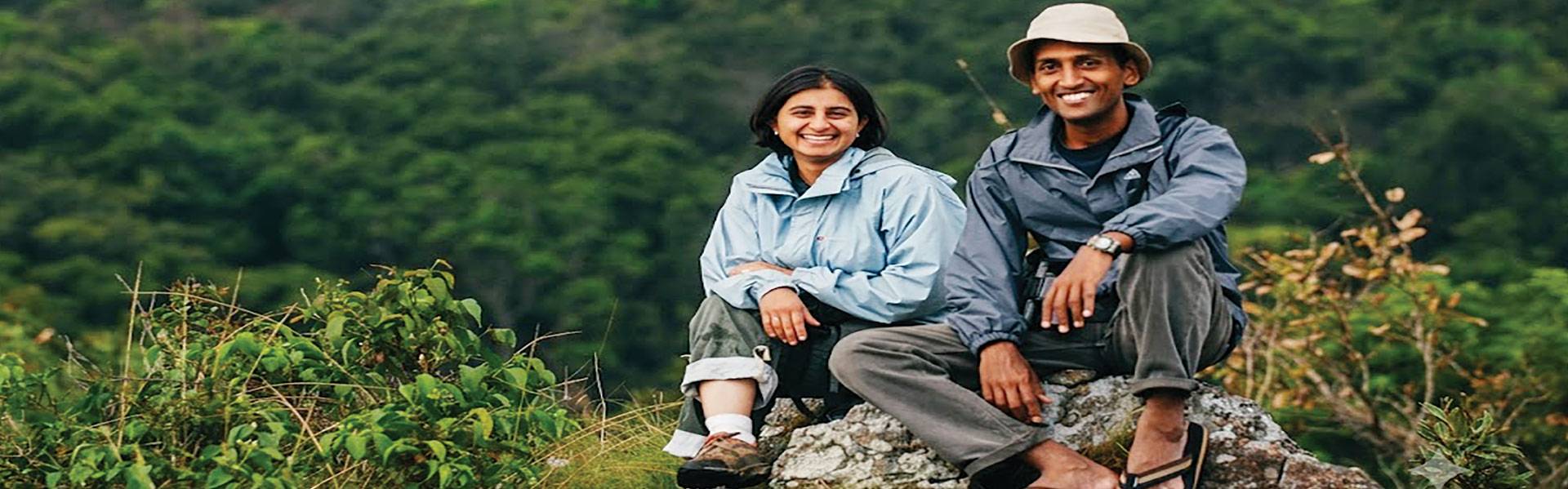
Meet T.R. Shankar Raman
First published in Sanctuary Asia,
Vol. 46
No. 10,
October 2026
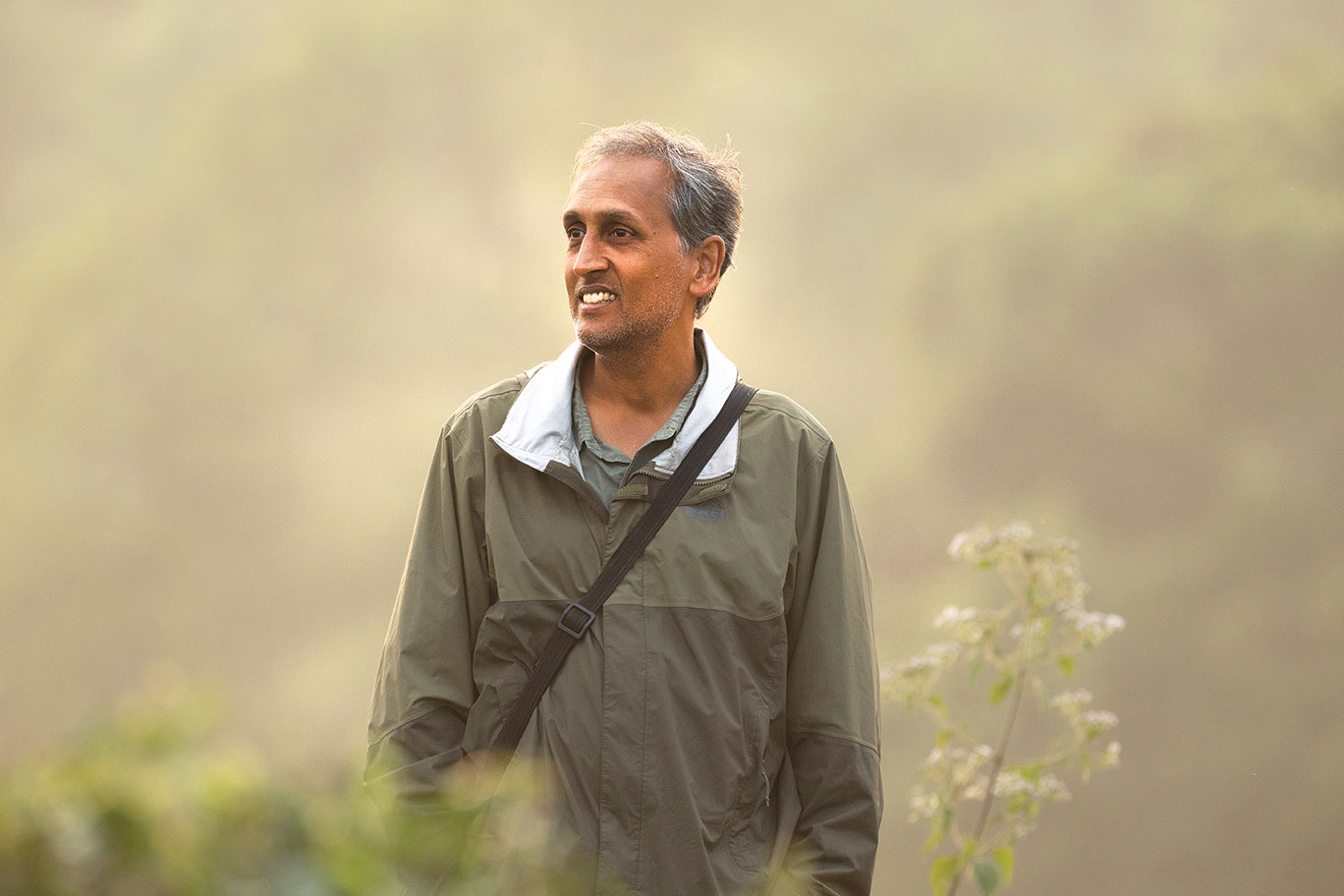
Photo: Kalyan Varma.
T.R. Shankar Raman dons many hats – writer, wildlife scientist, conservation practitioner, and Senior Scientist at Nature Conservation Foundation (NCF). Although interested in birds since his school days, his first research projects focused on the ecology of deer and antelope in southern India. As a writer, he is keenly invested in writing about ecology and natural history, and communicating issues related to conservation biology and practice to a wide audience through books, creative non-fiction essays, blogs, op-eds, and other media. Sanctuary Asia’s Senior Consultant Photo Editor and Naturalist Prachi Galange speaks with him about his ability to translate science into meaningful public action, and his vision and values for the future of conservation.
Tell us your origin story. How did trees and wildlife become an integral part of your life, and was there a formative experience that inspired you to become a biologist?
Tell an 11-year-old boy what he shouldn’t do, and then he just wants to do it. My story begins as a Chennai schoolkid told by my parents to keep my hands off the pair of expensive binoculars stashed away in the top shelf of a cupboard. It was meant to be used only for watching cricket matches at the Chepauk Stadium. I needed a really good excuse to use it for anything else. I discovered that excuse, one day, in an article I read in the children’s magazine Target about becoming a birdwatcher. Now, I could claim the binoculars every time I wanted to watch the parakeets, mynas, and babblers around my home! Once I started watching birds, I was genuinely captivated, and there was no single experience, really. I was also into gardening as a kid and all of it came together – the itch to be outdoors, to pay attention to plants, always alert for birds and other animals. My brother was also into birding and even as schoolkids we became members of the Madras Naturalists’ Society and joined them on field trips. I knew I wanted to be a naturalist or a field biologist even before 10th grade.
Why did you zero in on the Anamalais for your first project?
I came to the Anamalais in a rather circuitous way. My first field project was on a free-ranging population of chital and blackbuck in Guindy National Park, Chennai, during my Bachelor’s, often bunking college to spend time with the deer and the antelope. I went on to Mizoram to study shifting agriculture and conservation of birds and wildlife during my Master’s at the Wildlife Institute of India. This got me hooked on tropical forests, and that led naturally to my doctoral research at the Indian Institute of Science on birds in the tropical rainforests of Kalakad-Mundanthurai Tiger Reserve (KMTR) and the Anamalai Hills in the southern Western Ghats. I worked with Divya Mudappa, my partner, and other colleagues for many years learning about the rainforests. While KMTR had a largely intact rainforest landscape, the Anamalais had been fragmented by tea and coffee plantations and posed several challenges – degraded rainforests, human-wildlife conflict, and more. Teeming with wildlife, the Anamalais was best suited for long-term research and also needed on-ground conservation and restoration efforts. So that’s where we decided to drop anchor.
What has changed since you first arrived in the Anamalais, and what concerns you most?
If you take a Black Eagle’s eye view, the landscape does not appear to have changed much over the last quarter of a century that we’ve been here. The Protected Area name changed from Anamalai Wildlife Sanctuary to Anamalai Tiger Reserve. The Valparai Plateau remains dominated by tea plantations with embedded rainforest fragments. The most visible changes have been the widening of roads and the huge increase in traffic, tourists, and trash. The subtler, but equally significant, changes we noticed were the slow degradation of forests owing to linear intrusions, the spread of invasive species, changes in the behaviour of species such as lion-tailed macaques and elephants in their interactions with people. There is an erosion of the overall health of the rainforests, with the largest trees being particularly vulnerable, most likely on account of a combination of pressures such as climate change.
What has rewilding taught you that you’ve carried into your later projects, and into life?
I’d say two key learnings at least. First, we need to work with nature rather than against it. Ecological restoration is about lending a hand to revive ecosystems recognising that most of the revival happens through natural processes. Second, conservation requires sustained long-term engagement with people and places. Nothing happens in a flash. It took years of dialogue to strike partnerships with local landowners and over a decade of work on the ground before we began to see significant signs of rainforest revival. You have to face setbacks and disappointments and learn from them. And so the main lesson for life in general? Well: stay the course!

T.R. Shankar Raman and Divya Mudappa in the Western Ghats rainforests, where decades of research have advanced rainforest conservation, restoration, biodiversity studies, and human-wildlife coexistence. Photo: Kalyan Varma.
You are one of the founding members of the Nature Conservation Foundation (NCF). How did the idea of NCF come about?
NCF turns 30 this October. When we set it up in 1996, we were bolstered, you could say, by equal parts of naivete, foolishness, mixed perhaps with a little courage. Even today we joke that if someone asks why we started NCF, the best answer is: It seemed like a good idea at the time! We started off as a group of five friends who felt that we needed to engage deeply with places, species, and conservation issues, and build on scientific understanding of ecology and society to achieve conservation. Our idea was also to support motivated people. There were few institutions then that could absorb and support such people to pursue their interests. I must say that I never dreamed that NCF would grow to a 200+ strong institution or that I’d become a senior scientist myself running a wildlife research and ecological restoration programme for over 25 years.
Your work has had a large-scale impact. Does that give you confidence for a future where ecology is at the forefront?
I don’t think the scale at which we have succeeded is anywhere as large as we’d like. But certainly, the wildlife research, conservation and ecological restoration efforts of my colleagues at NCF and our teams working in the Western Ghats, as well as those of many others around the country, give me a lot of hope today. I do believe that people attuned to nature and to ecology can bring about positive change. I’ve written that ecology is the most important science of the present century. It doesn’t just help us better understand damage and devastation to the environment. It moves us to take inspiration in natural rhythms and cycles, work with nature’s powers of renewal, and appreciate the beauty of what we are also part of. And ecological restoration, in particular, requires an all-hands-on-deck kind of human involvement.
You’ve said science alone can’t solve conservation challenges. What’s the biggest mistake conservationists make when working with communities, and how should we navigate conflicts?
Being well trained in the scientific method can allow you to unravel ecological patterns and processes or pinpoint a species’ plight, but it does little to prepare you for on-ground conservation. Conservation requires people skills that allow for working with people with different motivations and interests, understanding their needs, and getting them to feel a part of nature. It is more often about changing human behaviour and worldviews than about understanding plants or predicting animal behaviour. My people skills are limited and I am not the best person to advise on working with communities. Yet, I feel strongly that the biggest mistake we make is believing that if affected communities are paid or compensated, an environmental problem will miraculously disappear. Putting a price on natural capital or ecosystem services, or dangling a more lucrative livelihood option are not magical solutions. A purely instrumental approach not driven by intrinsic or relational values, that lacks sustained engagement with people, and ignores aspects of social justice and equity, will probably be ultimately counter-productive.
Pivoting to your interest in writing… What motivated you to write, and about trees in particular?
I’ve always enjoyed writing. Here, too, Target magazine possibly provided an early impetus because I read an article on how to write by Anita Desai, a great writer whose novels I’d enjoy reading only decades later. Writing went with reading, and I read a lot. I was also particularly drawn to the essay form and began blogging around 2007 (which I still continue at ‘View from Elephant Hills’, https://shankarraman.in). As a naturalist, ecologist, and someone interested in conservation, I felt that entire dimensions of human experience in nature were missing in much contemporary writing, from India at least. To me essays seemed the natural form to bring out those experiences, that kind of witnessing. As for writing about trees, I did little at first – essays about great banyan and tamarind trees hacked away for roads, the loss of giant dipterocarps in Northeast India – in my book The Wild Heart of India. But living near the rainforests in the Western Ghats and trying to bring back native trees through restoration drew me much closer to them. Divya and I collaborated with artists to bring out Pillars of Life: Magnificent Trees of the Western Ghats in 2018, to draw attention to some of our wonderful trees. That book caught the eye of a publisher who asked if I would write about India’s trees, and that led to The Trees of My Country: A Natural History of India in 50 Trees. The book includes some of my favourite trees such as the Cullenia exarillata, locally known as vedipla, a tree like the wild durian, whose fruits are relished by the lion-tailed macaque.
What made you want to tell India’s natural history through individual trees?
Aren’t trees the absolute best beings to tell the story of our land? They are rooted to place, for decades to millenia, yet alive and full of vitality and movement, responding continuously to the environment and species around them. Their physical forms respond to their surroundings, the growth rings record histories in their wood, and their nature and associations reveal so much about themselves and the places they inhabit. India has such a spectacular diversity of natural ecosystems and trees. I felt that if I could make a careful selection of trees from the different places and far corners of India and tell their stories as best as I could, it would clearly reveal that extraordinary diversity, the fascinating natural histories, landscapes, and cultural associations, better than anything else could. Trees are not mere objects out there to serve us. They are living beings with rich lives and interests of their own.
Your books are treasure troves of illustration and emerging artists. How do these collaborations come about? Do you have a favourite style, and do you dabble in art yourself?
To give credit where it is due: this is entirely thanks to Divya. She has a better eye and aesthetic sensibility and has always reached out to great artists to strike collaborations that really enhanced our work. We were fortunate to work with brilliant artists who illustrated for a book on small carnivores that Divya did early on, and for Pillars of Life (with paintings by Nirupa Rao) later. Artists such as Maya Ramaswamy and Sartaj Ghuman produced paintings and murals at our Anamalai Nature Information Centre, in public spaces in Valparai, and for other publications. So it was natural for me to turn to artists for my books. The Wild Heart of India and At the Feet of Living Things (co-edited with Aparajita Datta and Rohan Arthur) have superb sketches by Sartaj Ghuman. Line drawings and pen-and-ink sketches, like Sartaj’s work (or those by Ralph Thompson for Gerald Durrell’s books), are my favourite, too. I try my hand at it sometimes, but I’m still a novice. The Trees of My Country needed the eye and hand of a skilled botanical artist. Manali Patil, who we’d worked with earlier for streetside murals, is simply superb and the result is there for you to see and admire in the book: 50 extraordinary paintings of trees in watercolour.
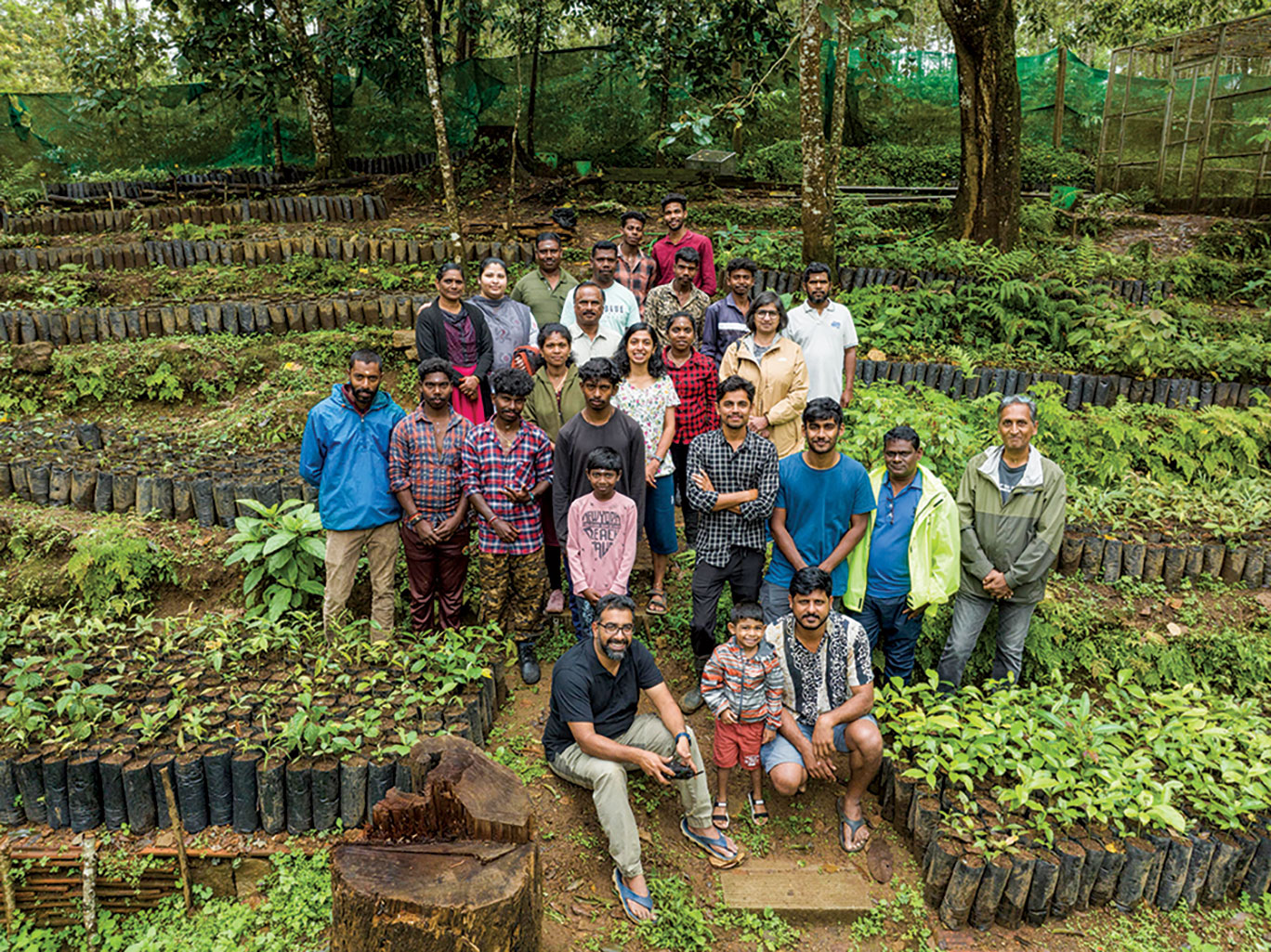
Shankar, Divya and their team at the Nature Conservation Foundation help rewild fragmented and modified agroforest and plantation habitats in the Western Ghats. Photo Courtesy: Ganesh Raghunathan.
You describe yourself as a ‘writer turned wildlife scientist turned writer’. What did each transformation teach you?
My initial forays into writing got pushed to the background when I became a wildlife scientist. My training did get me to understand the changes around me better, under a scientific lens. I switched to reading mostly nonfiction and science books at the time. It opened my eyes to natural wonders, to the importance of reasoning, logical thinking, and accuracy in communication. But the pain of witnessing ecological degradation and damage, seeing places we loved despoiled, species we knew disappearing, drew me back to writing, and back to literature, novels, essays, and poetry. That also came with a realisation that while science can help understand the world better, it has a very limited role in bringing people together or in fostering social change. As humans, our emotions, ethics, philosophies, aesthetic sensibilities, indeed our humanism itself, all need to be fully involved. Art and the humanities speak to that cause better than science. I felt that as a writer, as an artist, I’d perhaps be able to do better justice to what was at stake.
Has writing changed the questions you ask as a scientist?
Not as much as it probably should, since there is a lot of inertia and regimentation in academia, and in the scientific method that is hard to break. I do think my writing has lent a certain humility, to at least avoid being hubristic about our research findings or accomplishments. Writing also helps me clarify my thinking. It lets many doubts and an awareness of my own ignorance bubble up to the surface. Which I think also helps put our own scientific work in perspective. From writing about animals and plants as beings, and about sentience in nature, I do feel that we should rework many of our scientific questions and methods to accord greater agency to the species and ecosystems we study. But that’s a whole other topic for another day.
What are you currently working on, and what is your advice for someone who wants to write about nature?
Divya and I are editing a book on the hornbills of India, to be published next year. And I’m mulling over my next book... My advice? Don’t listen to me! Ha ha... What I mean is that there is a need for original experiences and new voices, rather than going by what someone suggests or wants, adopting a particular style, or trying to emulate someone like, say M. Krishnan. So if you feel powerfully that you have something to say, find the best way to say it. Indian nature writing is undergoing a revival, or as Neha Sinha recently wrote, a tectonic evolution. If I had to make a suggestion, I would first suggest reading widely and deeply, classic works by people like Rachel Carson, Loren Eisely, Aldo Leopold, and M. Krishnan, more recent authors like Barry Lopez, Kathleen Jamie, Amitav Ghosh, and Meera Subramanian. Must-read Indian authors writing on nature include Janaki Lenin, Arati Kumar-Rao, Neha Sinha, Yuvan Aves, Prerna Bindra, and the Roy triumvirate: Anuradha Roy, Arundhati Roy, and Sumana Roy. If there’s some lacuna in nature writing in India, I feel there is still space for readable prose that provides a rich immersive experience of nature that is well-informed, evocative, and moving, without becoming preachy, sentimental, or solipsistic.
What’s on your ‘to-be-read’ pile?
My tsundoku pile is huge. I’m just finishing Everything the Light Touches by Janice Pariat and next on the list are Wild Capital (Neha Sinha), Restless Waters of the Ichhamati (Bibhutibhushan Bandhyopadhyay), Mother Mary Comes to Me (Arundhati Roy), How Flowers Made our World (David George Haskell), Earth Prayers: Encounters in Poetry with the Natural World (Carol Ann Duffy), and Subversions (Shashi Deshpande).
How do you let your hair down, and what does your typical day look like?
I unwind watching bad Hollywood action flicks (the likes of Transporter) tempered by an occasional good Indian movie – the latest being Main Vaapas Aaunga with Naseeruddin Shah (I cannot bear to watch bad Indian movies). I’m also reading all the time... anything I can lay my hands on from poetry and pulp to classic literature, westerns, novels, translations, memoirs, essay anthologies, and nature writing, of course. I listen to old Hindi songs (although much less than earlier), go cycling (if the cycle has been repaired), or play with Sootypoo, our cat. Birding, fortunately, remains a hobby, too! And at least once a year, we travel. My typical day is too varied and depends upon the season. Most days begin early with too much coffee and whistlingthrush song – I do much of my writing then. The mornings are for visits to the rainforest nursery or field sites or for office work – often project proposals, scientific papers, and reports. We often have visitors who we take around to show our work in the landscape. Afternoons, we have online meetings and catch up with our team who bring news back from their day in the field from hornbill transects, phenology surveys, restoration sites and the like, and plan for the day ahead. Occasionally, we go for an evening drive to watch wildlife at some favourite sites, perhaps spot a flying squirrel or two on the way back after sunset if we are lucky. And at night, back to Terminator or Mukesh or Janwice Pariat…
Is India’s biodiversity facing a systematic assault in the name of development? With the Great Nicobar project as an example, how do we bring scientific and ecological sense to decisions driven by development and security, and underscore what’s at stake?
There is undoubtedly a tremendous onslaught on India’s forests: from mining, industrial expansion, roads, and the like. Scientists and writers have a responsibility to raise and discuss these issues, to question the trajectory of development: who is it really for and who pays the costs? We need to change the debate away from an environment versus development framing, and speak clearly about what is really at stake and what alternatives exist. As for projects like in Great Nicobar, the security needs can surely be met without all the damage that comes with the planned commercial and tourism-related activities such as building a new port and airport, an entire township, power plants, along with an explosion of tourist resorts up and down the coast of this fragile island. As citizens we should be concerned about this, raise questions, lend our voices in support of the Indigenous People, and push for a reconsideration or rejection of such destructive projects.
With AI, data centres and biodiversity loss reshaping our future, how do you give people hope, and help them build a nature-centric one?
Much as I like watching and reading dystopian sci-fi, I don’t think we are in that future (yet). Understanding that we are part of nature and keeping that central to everything we do can help move to different ecological futures. We can act as individuals making changes in our own lifestyles. We can gather in communities or support civil society groups that are acting to bring about changes around where we live. We must also engage with campaigns and larger political issues to challenge development trajectories and bring about policy changes, for instance, in shifting the world away from fossil fuel dependence. All of this is needed and everyone has a role to play.
After a lifetime of studying and writing about the natural world, what do you think we still fundamentally misunderstand about our place in it?
As I mention in the opening sentence of my book The Wild Heart of India, the most fundamental misunderstanding is that nature or the natural world is something out there in some far away forest or wilderness, rather than something that we are embedded in and which we are a part of.
Looking 50 years ahead, what gives you hope for India’s landscapes, and what keeps you awake at night? What one piece of advice would you give a young biologist entering conservation today?
What gives me great hope is the stellar and growing crop of young conservationists working around India today, and that many of our Indigenous People continue to show us how to live gently on this Earth and defend it – there is a lot we can learn from them. What keeps me awake at night is the unrelenting pace of change, driven by a neoliberal economic tide and a kind of industrial-political nexus that tries to bulldoze its way past everything, affecting human lives and destroying so many beautiful ecosystems. And the message I have for any young biologist entering conservation today is simply this: we need you.