Tipping Into Trouble
First published in Sanctuary Asia,
Vol. 46
No. 10,
October 2026
By Praveen Gupta
Every wild land mammal on Earth – elephants, deer, wolves, mice and the rest – adds up to only about 20 million tonnes, a 2023 study estimated, roughly three kilogrammes per person, compared with about 390 million tonnes of humans. We are transcending our planet's safe operating space by monopolising land and oceans – vis-à-vis all creations, unleashing our destructive might. Humanity is using nature 73 per cent faster than ecosystems can regenerate, which is the equivalent of living off 1.73 Earths, according to the Global Footprint Network.
Science has given us the power to find solutions, but we resist deploying them. We are in a classic #grayrhino situation – a high probability, high risk event that can be seen approaching but nothing is done about it until it is upon us, like a person stepping away too late out of a charging rhino’s path. Yet, insurers continue to look the other way.
My random A to G pathway for insurers is not merely a nudge to ensure mitigation, adaptation and resilience, but is also fashioned as navigational input through systemic and existential times.
The AMOC
Amongst the many manifestations of climate breakdown, the one most threatening is the AMOC. I have said much of what one must say about the Atlantic Meridional Overturning Current (AMOC) in June 2026 Sanctuary Asia (A Civilisation-Ending Event You Never Heard Of?). Despite growing evidence of its slowing and the adverse implications for much of the planet, Iceland is the only country that has accepted this probability and declared a national security threat.
Bittu Sahgal, Editor, Sanctuary Asia, and I had the pleasure of connecting with Susanne Ditlevsen, President of the Royal Danish Academy of Science and Letters. Her research brings forward the earliest likely tipping of AMOC to 2037. While the insurance industry prefers to be an ostrich, Institute and Faculty of Actuaries (IFoA) deliberates in Parasol Lost: Recovery Plan Needed that “without action, global warming is now likely to reach 20C before 2050.
This raises the risk of climate-driven inflation, financial shocks, and the withdrawal of insurance from high-risk areas much sooner than many expect which, in turn, increases the chance of widespread financial instability and ‘Planetary Insolvency’ – the risk of societal and economic collapse from the loss of nature’s critical support systems.”
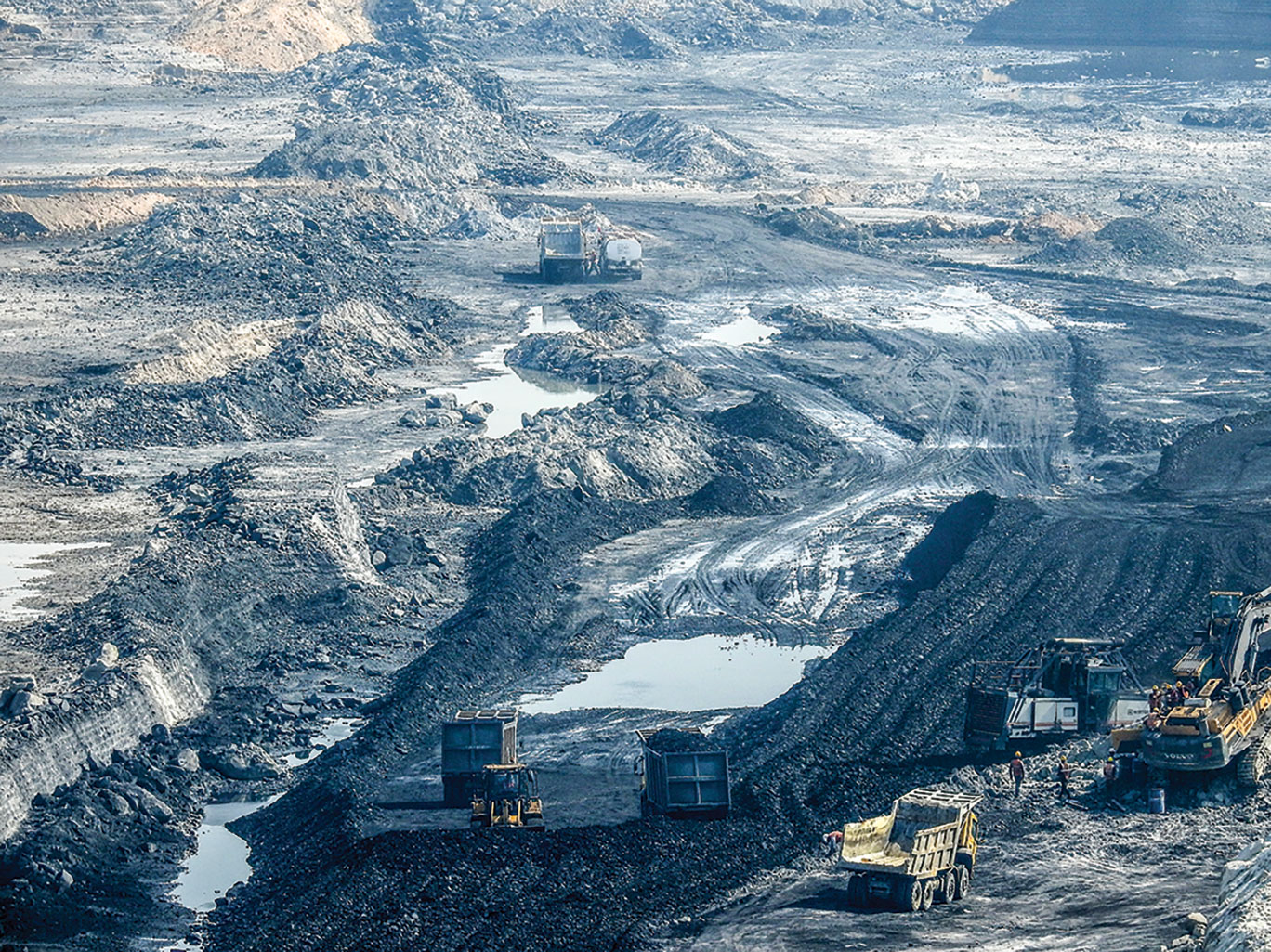
Extracting resources aggressively pushes habitats and biological communities toward sameness. Photo: Pranav Capila.
Biodiversity And Habitat Heterogeneity
Andrei Ionescu of Earth.com explains why biodiversity is nature’s best insurance against climate change, citing a new study:
1. The things people do to a landscape tend to flatten exactly the variety an ecosystem needs to stay resilient.
2. Converting land, introducing invasive species, or extracting resources aggressively push habitats and biological communities toward sameness.
3. And once that sameness sets in, the buffering capacity that portfolio effects normally provide starts to disappear along with it, leaving ecosystems harder to predict and more vulnerable to real, lasting decline.
4. Variety among habitats matters because a disturbance almost never hits a whole landscape evenly. The patches that stay intact end up propping up the ones under stress.
5. Variety among species and populations matters for a different reason entirely: it gives a community room to reshuffle itself under new conditions while still doing its job, still producing the resources everything downstream depends on.
6. These forms of variation aren’t independent of each other. They reinforce one another, which is exactly what lets an ecosystem bend under pressure instead of breaking.
Kayla Hale, lead author of the study, says: “Protecting this variation helps maintain the capacity of ecosystems to respond to both expected and unexpected environmental challenges… This work highlights biodiversity and habitat heterogeneity as a form of natural insurance.”
Carbon: “The Debt Has Come Due…
This summer the collector stopped warning and started billing.
Two centuries of unpriced carbon debt, and the interest – methane, 82 times more potent than carbon dioxide over twenty years – is compounding now, arriving every July slightly larger and slightly sooner. One bridge loan sits unused: coal mine methane abatement. Cheap, fast, additional and barely tapped. That's this issue,” says Kaj Embren, Climate Policy and Energy Transition Advisor.
Each dollar of extra global energy efficiency has come with 16.9 additional gigatonnes of emissions. Efficiency isn't shrinking demand but feeding it.
“Multinationals, states and finance shape rent-seeking, geopolitical pressure, trade rules, financial conditions. Those shape what actually gets invested in. Fossil fuel returns keep beating renewable returns, structurally. That's not a footnote. That's the mechanism. Without managing global demand for energy and materials, the transition doesn't arrive in time. The market isn't failing to fix this. It's doing what markets do: following the money to where the returns are highest. That's fossil fuels. Until we change that, no amount of solar panels changes the total,” reminds Hans Stegeman, Chief Economist at Triodos, one the world's leading sustainable banks.
Decarbonise Now
Carbon capture gasps for a breath of fresh air! Nick van Osdol and Paul Gambill authors at keepcool.co tell us why: “The Intergovernmental Panel on Climate Change (IPCC) has often emphasised that pathways to limit global warming to 1.50C require billions of tonnes of carbon removal because even with rapid emissions reductions, residual carbon dioxide buildup will linger in the atmosphere for centuries. We need to scale carbon removal to 10 billion tonnes per year by 2050. That would mean we should aim for 285 million tonnes per year by 2030. Current global carbon removal deliveries are in the order of hundreds of thousands, nowhere close to billions. Gigatonne carbon removal implies step changes of many orders of magnitude.”
Carbon Tracker: Through its Regulatory Sandbox and planned Climate Scenarios Cohort, the Financial Conduct Authority is now looking at approaches that account for tipping points, compounding risks, non-linear impacts and deep uncertainty.
This development has been welcomed because climate risk is not always gradual or predictable. Extreme weather events can overlap, tipping points can accelerate damage, and financial impacts can materialise faster than conventional models assume.
In 'Loading the DICE Against Pensions' and 'Recalibrating Climate Risk', produced with the University of Exeter, Carbon Tracker warns that conventional climate damage models can understate physical risk and give financial decision-makers a false sense of security.
Decarbonisation must focus primarily on the reduction of consumption levels in the Global North, and supply-side management, leaving 90 per cent of the remaining fossil fuel reserves in the ground. And, on Nature-based Solutions (NbS), with a thrust on climate and social justice. In addition, decarbonisation strategies must do away with failed, untested, hypothetical market-based solutions and techno-fixes. Through these means, gross global consumption should be reduced to sustainable levels, the measure for which should be a quantifiable justice-centric sustainability index.

Biodiversity provides natural insurance against climate change, strengthening ecosystems’ resilience and ability to withstand both predictable and unexpected environmental challenges. Photo: S.G. Ganesh/Sanctuary Photolibrary.
Earth’s Energy Imbalance (EEI)
This is at the root of global warming. With the demise of the Net-Zero Insurance Alliance (NZIA), we are missing the opportunity to decarbonise much of what insurers could otherwise do.
Prof. Anders Levermann of the Potsdam Institute for Climate Impact Research warns that climate tipping will manifest as a period of increasingly dramatic weather volatility, rather than a sharp shift in average conditions. A fluctuating climate will bring swings and crashes in crop yields, flash flooding, and erratic storms. It will stress economies by disrupting supply chains and amplifying insurance losses. Societies are unprepared, because weather volatility related to tipping points is absent from risk assessments.
Earth is reflecting less sunlight back into space, The Economist reported, thereby rapidly increasing Earth’s Energy Imbalance and making the world hotter. This fundamental driver of global warming has doubled since 2000. Earth is now warming at a rate of around 0.35 C per decade according to Alexandra Witze in nature.com. Earth subsystems, including oceans, the cryosphere and biosphere, already seem to be destabilising. The planet is heading for climate free fall. It takes a lot of heat and therefore time to melt land ice (especially the kilometres thick Greenland and Antarctic ice sheets), but “we're heating the climate in a geological instant with our greenhouse gas emissions,” says Leon Simons, eminent Climate and Energy researcher.
We tend to ignore the harm we cause to our oceans. They are not just getting warmer, but also storing enormous amounts of energy that can intensify weather far beyond the coastline, explains Philippe Curchod, Associate Founder, Data Analyst AI – Information Management.
NOAA estimates that 28 per cent of the global ocean is experiencing marine-heatwave conditions. People living on land should be concerned, he reminds. The ocean has absorbed more than 90 per cent of the excess heat trapped in Earth’s climate system. This has slowed atmospheric warming, but it has also transformed the seas into a vast reservoir of accumulated heat.
Exceptionally warm seas raise humidity and reduce night-time cooling, making nearby heatwaves feel even more dangerous. The combination of heat and moisture can severely increase stress on the human body.
Tropical cyclones draw their energy from warm ocean water. Higher temperatures can support rapid intensification and heavier rainfall, while rising sea levels allow storm surges to push farther inland.
Natural large-scale ocean patterns such as El Niño redistribute heat across the planet, shifting rainfall, drought, temperature and storm patterns thousands of kilometres away.
The ocean does not independently cause every hurricane, flood or heatwave. But climate change is adding more heat and moisture to the entire system, creating conditions in which extreme events can become hotter, wetter and more destructive.
These shifts are directly connected to public health, agriculture, infrastructure and the safety of communities worldwide, reminds Philippe Curchod.
Fossil Fuel
Here is a stark warning from the National Emergency Briefing (UK): The climate we live in today is the least extreme climate you will experience in your lifetimes because of ongoing fossil fuel emissions, yet insurers continue to dither.
A new ShareAction benchmark assessed 40 of the world's largest insurers. The conclusion is striking – progress on climate and nature has largely stalled since 2024. Most insurers have climate commitments. Many have fossil fuel restrictions. Yet conventional oil and gas expansion remains overwhelmingly insurable, treaty reinsurance remains a major loophole, and only a minority actively support climate adaptation.
Only 35 per cent of insurers actively support climate adaptation. Nature is rarely integrated into catastrophe models. Engagement policies often exist without meaningful escalation. Most innovation still focuses on mitigation rather than reducing the underlying drivers of future losses.
Insurance is extraordinarily effective at distributing losses after shocks occur, says Patrick Schmucki, author of The Adaptive Edge. It is far less effective at changing the structures that make those shocks increasingly expensive. This is not a failure of the insurance industry. That's how the system has been designed.
Schmucki believes different incentives are required: Accounting that recognises avoided losses, capital frameworks that reward lower structural risk, regulation that values resilience rather than simply solvency and business models that see insurers not only as risk carriers, but as architects of more resilient systems.
The insurance protection gap is often presented as a problem of insufficient insurance. However, he says, it is a problem of insufficient resilience. Closing the protection gap ultimately requires reducing the risks that need protection in the first place.
Part of this is about the insurance business model, which is built on 12-month renewal cycles, rather than, say, a 20-year forward price curve. Then, there are the future discount rates for capital projects, which can make potential risks disappear mathematically even if they still exist in real life, reminds Anthony Hobely.
Geoengineering
We have geoengineered the planet thanks to our multiple onslaughts. With most climate models failing, would we be compelled to deploy solar radiation technology before we can regenerate nature and cool down just ahead of tipping cascades into a point of no return? Many environmentalists and scientists abhor the idea. Among their objections: It doesn’t address the rise of atmospheric carbon dioxide, which causes ocean acidification and kills coral reefs. It’s a short-term fix for a long-term problem, since carbon dioxide lingers for centuries and aerosol particles fall to the surface in just a couple of years. Critics say that even discussing this kind of geoengineering could sap momentum from efforts to cut carbon emissions.
“Geoengineering is pretty much a blind alley,” said the late Richard Heinberg, senior fellow of the Post Carbon Institute and a visionary. “We’re probably not going to be able to solve climate change with techno-fixes. We’re actually going to have to change our behaviour and our expectations and our economy. Nobody likes to hear that.”
Ecosystem destruction, ocean acidification, loss of biodiversity need to be remedied if we must cool the planet, explains Rob de Laet. While we do this, we race against time. Can insurers help bypass a stalling Earth System by deploying Geo-engineering? I draw from the IFoA paper alluded to above in my recent presentation at China International Conference on Insurance & Risk Management. Geoengineering is not a substitute for emission cuts but may serve as a temporary complement. Insurers, facing existential risks to their industry, could help shape responsible exploration of geoengineering interventions.
In the prescient words of Richard Heinberg: “If we don’t squarely face the limits to our agency, we will hallucinate unreal solutions to our proliferating problems”. And as Schmucki puts it, “The central challenge is increasingly not knowing what may happen. It is building institutions capable of acting while the future is still uncertain.” Can insurers rise to this occasion?
Will the actuaries assert for climate breakdown as they did for P&I insurance at Hormuz? Parasol Lost is a tool to deploy as we buy time trying to get our act right? Glacial Lake Outburst Flows (GLOFs), floods, droughts, wildfires, heatwaves, sea level rise, Earth systems tipping et al, are an ever-growing list with no regard for political boundaries and siloed ways of insurers. Rendering us all uninsurable is incidental. Is it time to say goodbye to goldilocks
Praveen Gupta is a former insurance CEO. He believes insurers – like other financial services – have a critical role to play not only in nurturing our environment today but also ensuring planetary well-being for the long term.