Woman-led Conservation Excellence
First published in Sanctuary Asia,
Vol. 46
No. 2,
February 2026
The Balipara Foundation Awards 2025
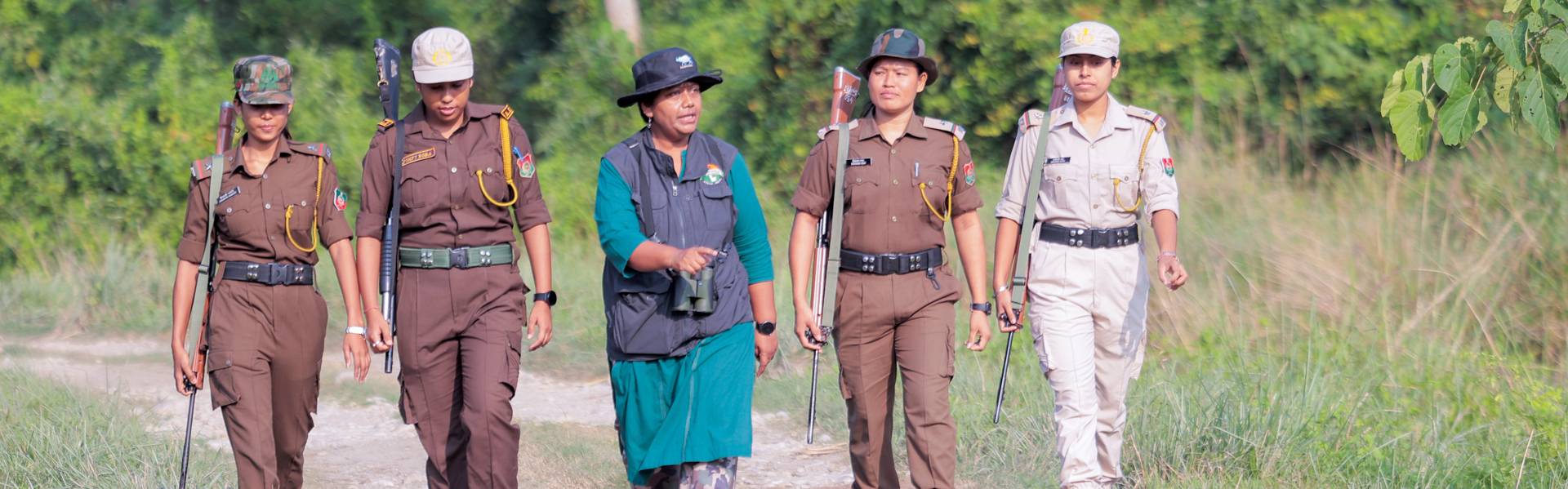
At dawn, just as the sun begins to cut through tall tropical trees, and mist lifts from swampy grasslands, an all-woman team prepares to move out from King Cobra Camp in the Agoratoli Range. They test their radios, check their rifles and tighten their boots to venture out into the wild. No ceremony, no announcements, just readiness. The women leading this patrol do not pause to mark the significance of the moment, focused only on the job at hand – protecting the national park from poachers, checking habitat degradation and building trust with communities to checkmate the illegal wildlife trade.
Established in August 2023, the King Cobra Camp is home to India’s first all-women anti-poaching unit operating in one of the world’s most vulnerable and fiercely protected wildlife landscapes – Kaziranga National Park, Assam.
Also known as ‘Van Durgas’, these female rangers have made Kaziranga a symbol of gender equality in wildlife conservation through their bravery and zeal. Led by Dr. Sonali Ghosh, Director, Kaziranga National Park, and Range Officer Bidyut Bikash Bora, the unit patrols the national park’s floodplain forest – an unforgiving terrain that challenges even the most seasoned forest guards. Dotted with tall elephant grass and shaped by seasonal floods, the everyday reality of the rangers is tough, having to perform their routine duties in the face of the constant threat of armed poachers.
Little wonder this earned them recognition in the Ranger Excellence category at the Balipara Foundation Awards 2025.
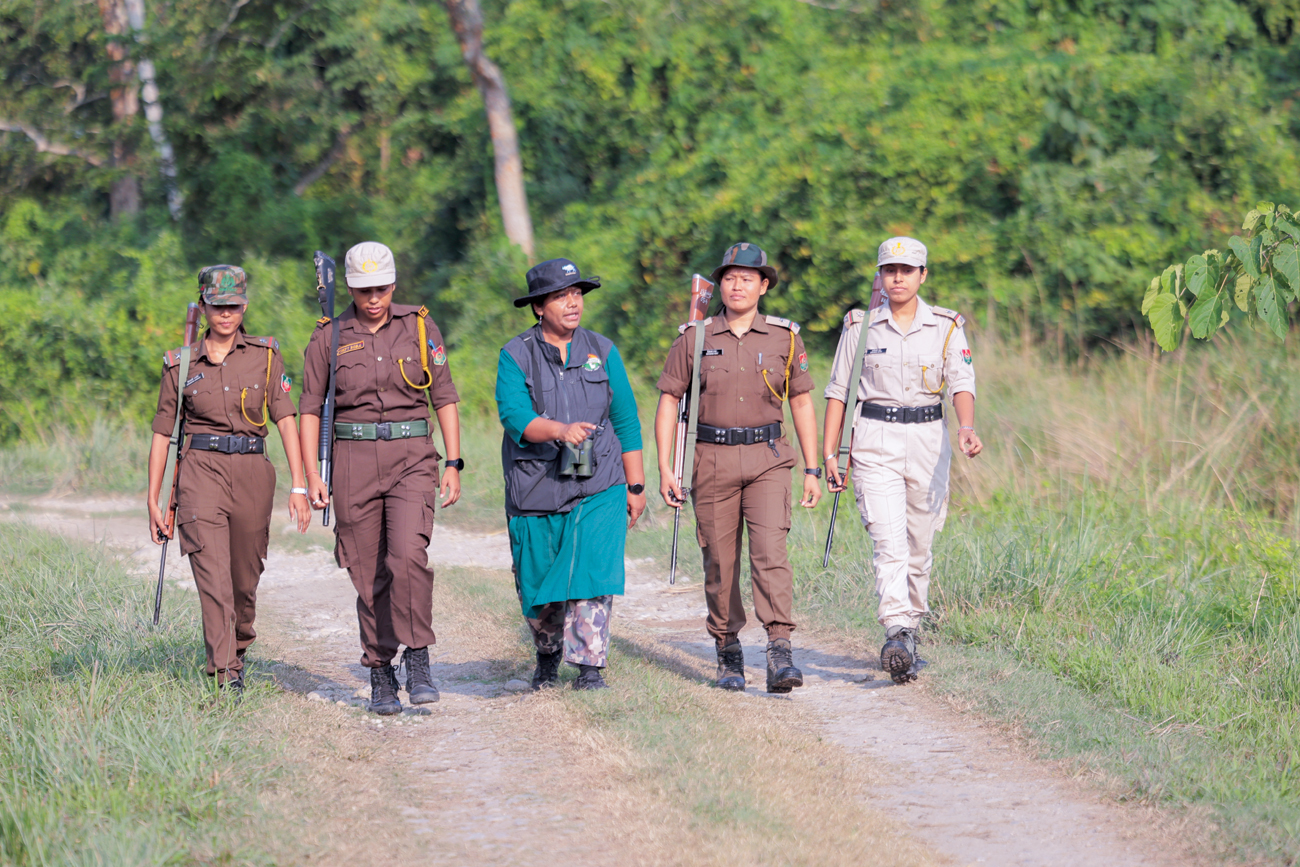
Under the leadership of Dr. Sonali Ghosh, Director, Kaziranga National Park, Sanctuary Wildlife Service Awardee 2025, and Range Officer Bidyut Bikash Bora, the unit patrols the National Park’s floodplain forest – a terrain infamous for being unforgiving even for seasoned forest guards. Photo Courtesy: Dr. Sonali Ghosh.
The Awards
The Balipara Foundation Awards were created to recognise leadership that is not always visible but is critical and deeply consequential. Across South Asia’s forests, farms and frontier landscapes, conservation is shaped by decisions made on the ground more than paper declarations. Rangers, community leaders, scientists and institutions, however, operate invisible at this interface, often without recognition.
Since their inception 13 years ago, the Balipara Awards have honoured over 184 Eastern Himalayan Earth Heroes and institutions, most working away from sight in forests, farmlands, rivers, and fragile frontier landscapes. Collectively, their efforts have contributed to the protection of uncounted species and the conservation and restoration of over 12,000 ha. of wild land. These outcomes are not the result of singular interventions, but of long-term, location--based leadership that values patience over publicity and resilience over short term wins.
More than celebrating isolated success stories, the awards spotlight patterns of resilience and approaches that inform policy, inspire replication and reshape conservation leadership.
Women Who Lead
This year's Award to the King Cobra Camp underscored the effectiveness of a vital shift underway in Assam’s conservation framework, based on gender equity.
The women of the King Cobra Camp have successfully built relationships with communities rooted in respect more than authority. This has helped forest officials to intercept poachers before they cross into Protected Areas. Conservation here has proven to be effective without always relying on force.
Across award categories, what resigned supreme was the strategy of investing on people working at the margins of visibility for landscapes under pressure.
Rooted in action rather than rhetoric and optics, the women of King Cobra Camp remind us that successful conservation can best be built, quietly, at the grassroots in the absence of noise and ceremony.
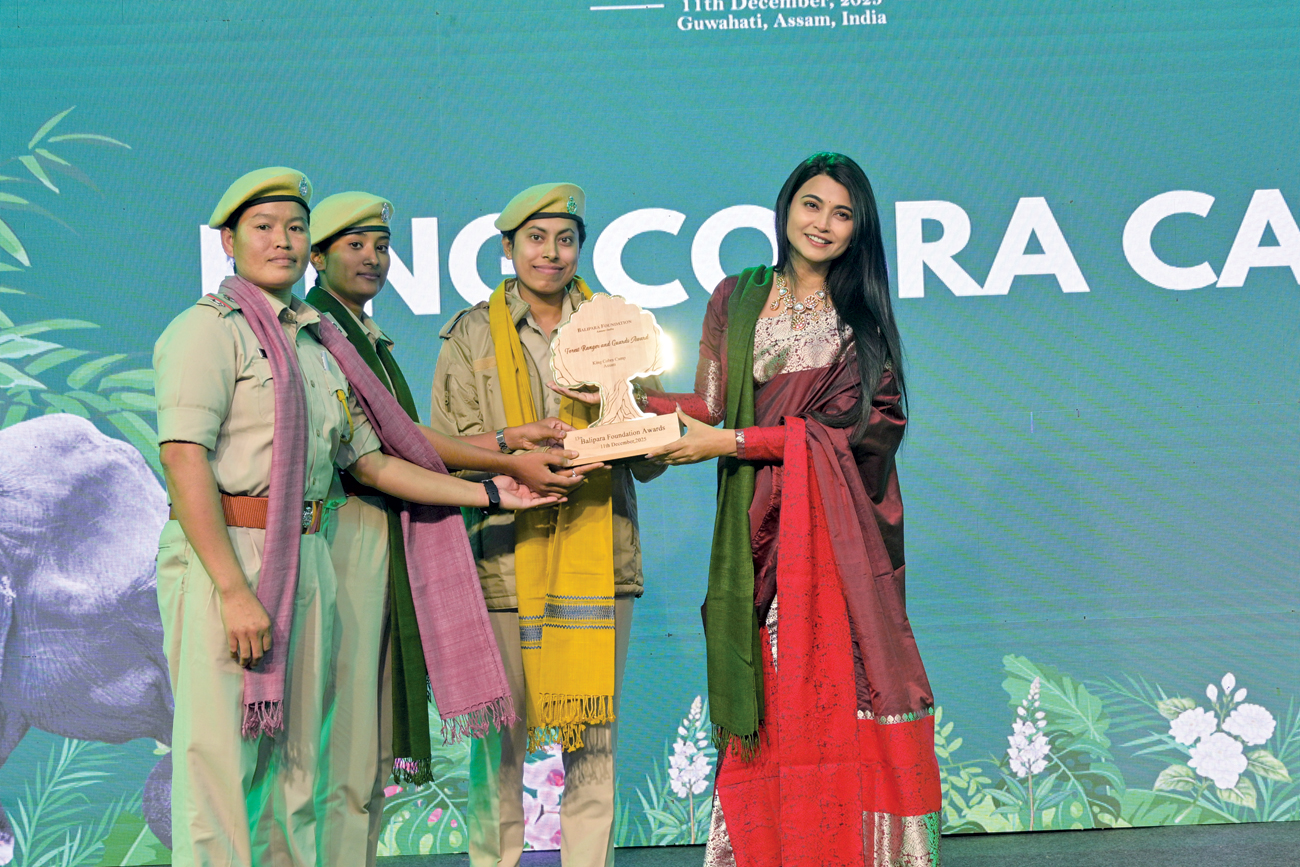
The Balipara Foundation Awards 2025 chose the all-women patrol team of King Cobra Camp, Kaziranga, in the ‘Ranger Excellence’ category, to highlight the effectiveness of women in command of responsibility and to underscore that gender equity in conservation is not an optional concern but a strategic imperative. Photo Courtesy: Balipara Foundation.
Winners
Rewilding Award
Jaubari restoration Camp, Nepal
NaturenomicsTM Award
Nyukmadung Village, Arunachal Pradesh
Green Journalist Award
Yimkongangba, Nagaland
Sohanur Rahman, Bangladesh
Green Guru Award
Betsida Marak, Meghalaya
Young Naturalist Award
Bijiyashanti Tongbram, Manipur
Sonam Wangcuk Lepcha, Sikkim
Food for the Future Award
Kuki Basti and Changlong Para Village, Tripura
Forest Ranger and Guards Award
King Cobra Camp, Assam
(Lokhimoni Dutta, Jitamoni Kakoti, Pompy Bora & Priyanka Pegu)
Forest Ranger and Guards Award
Hukai H. Zhimo, Nagaland
Ngawang Choizom, Bhutan
Lifetime Service Award
Dr. Kushal Konwar Sarma, Assam
Indian Eastern Himalayan Grant
Zoram Entu Pawl, Mizoram
Certificate of Honour and Gratitude For Selfless Dedication to the Eastern Himalaya
Chanakya Chaudhary
Honouring 35 Years of Aaranyak
Aaranyak (Represented by Dr. Bibhab Kumar Talukdar, Founder)
NaturenomicsTM Honour for Environmental Storytelling
Mike H. Pandey, India (Represented by Nicholas Claxton, Partner, WOW Media Communications Group)
Eastern Himalayan NaturenomicsTM Special Recognition for Innovation in Bamboo Bioethanol
Numaligarh Refinery Limited, represented by Bhaskar Jyoti Phukan, Managing Director